Wednesday, April 3, 2019

Strategic HRM in Gaining Competitive Advantage

Competitive advantage,  the concept founded by Michael Porter  in  1985. also he created a framework in order to gain competitive advantage and organization to become unique form their opponents. (Armstrong, M.2006)
Source:https://slidemodel.com/templates/industry-analysis-powerpoint-template/matrix-model-of-porters-generic-competitive-strategy/
   1. Cost Leadership & Cost focus

Companies are always moving to become successful.  to compete in the market company should have an edge over their competitors. purpose of executing cost leadership strategy is to increase the market share and gain higher profit margins at a given price. with implementing Cost Leadership the firm will able to survive in the market by offering a high product at a lower cost since it will increase their no of sales. (Farooq,U 2016)

 2. Differentiation / Innovation & Differentiation focus

Separating companies' product or services from other competitors in the same industry by making the product or service different than competitors. some examples of differentiation strategy as follows, (Tanwar, R. 2013 )
  • Product Performance.
  • Quality of product & service.
  • Durability.
  • Brand Image.
  • Functionality.
As stated before, in order to implement the above strategies, the company will require to have the necessary skills and knowledge. both strategies are connected with human skills, knowledge and as well as their productivity, commitment and efficiency. Therefore, managing human resource wisely and strategically will be very important, while implementing strategies. furthermore, Implementing both Cost leadership strategy & differentiation strategy in the organization is challenging since the firm will require to have a strong monitoring and analyzing system. below table exhibit the key requirements, that organization should have to implement the above two strategies. (Armstrong, M.2006)

Linking HR and Competitive Strategies


Source: Armstrong, M.(2006) Strategic human resource management: a guide to action (p62)

How HR can be used as a Competitive Advantage and what it's role?

Analyzing Data

With analysing organizational data HRM can determine the efficiency or high-performance employees. Moreover, they can determine the unique skills of employees with analysing their past performance, their level of education, which area they specialize in (Marketing, Production planning, branding, engineering, etc.).  also, the HRM department can use those data to carry out the strategic positioning of employees and utilize.  (Miller, B 2017)

Effective Recruitment

Hiring the right employees and positioning them for the right position is very important to achieve organizational goals. HRM department will allow the organization to have talented and knowledgeable professionals to execute organizational strategies.  (Miller, B 2017)

Designing, Training & Development

Employee training and development will help the organization to retain its employees. Furthermore, it will increase job satisfaction, moral, level of motivation, and also it will help to reduce employee turnover as well. (Miller, B 2017)

Reference :

  • Armstrong, M.(2006) Strategic human resource management: a guide to action.3rd ed. London, Kogan Page.


  • Tanwar, R (2013) Porter’s Generic Competitive Strategies. IOSR Journal of Business and Management, 15 (1), pp 11-17.


Wednesday, March 27, 2019

Strategic HRM and Competitive Advantage

How is SHRM effecting on the company’s competitive advantage? Philip Kotler defines the competitive advantage as “An advantage over competitors gained by offering greater customer value, either by having lower prices or providing more benefits that justify higher prices” (Kotler. P & Armstrong G. 2011). The competitive advantage always has to be unique which impossible to duplicate and It is differentiating the company form their competitors.  therefore, the sustainability of competitive advantage is very important to compete effectively and to survive in the market. 

Furthermore, the competitive advantage will determine, by the organizational capabilities which can be divided as distinctive capabilities and reproducible capabilities. distinctive capabilities defined as unique characteristics; the organization has which is hard to duplicate. Technology, innovation, marketing, quality, are some example of distinctive capabilities. If the organization is aware of their distinctive capabilities, it can develop as a competitive advantage. Most of the distinctive capabilities are combined with humans, such as Knowledge, experience, expertise, skills and the level of commitments. (Armstrong M. 2006)

Reference :
  • Armstrong, M.(2006) Strategic human resource management: a guide to action.3rd ed. London, Kogan Page.
  • Kotler,P., and Armstrong, G.(2011) Principles of marketing.14th ed. New Jersey, Pearson.

Human Recourse Management & Strategic Human Recourse Management


There are different interpretations has given for Human resource and human resource management by several people. As stated in Human resource management – Theory and practice, Human resource management (HRM) is a strategic approach to managing employment relations which emphasizes that leveraging people’s capabilities is critical to achieving a competitive advantage, this being achieved through a distinctive set of integrated employment policies, programmes and practices. (Bratton, J., and Gold,J, 2009, p7)

Models of HRM


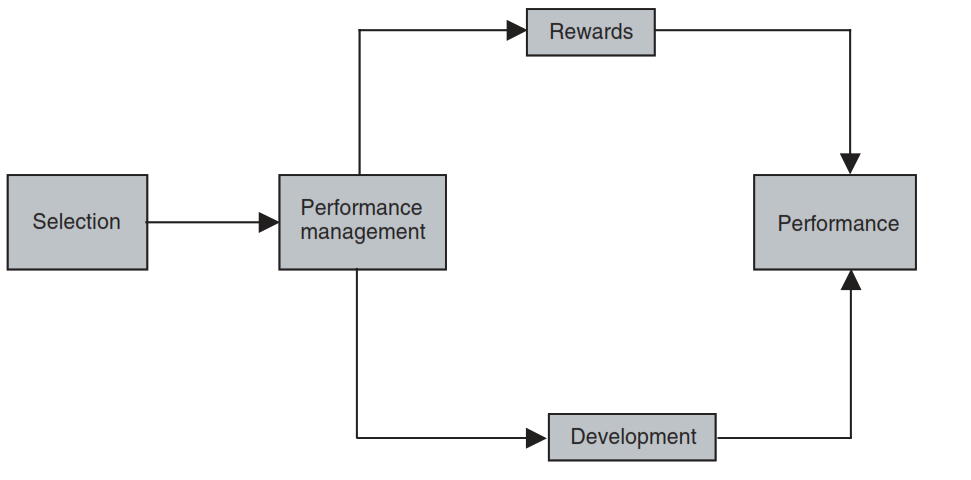
As stated in Strategic human resource management: a guide to action, Michigan School made the first clear statement for HRM as below, Furthermore, they stated HR system and the structure of the organization should be managed equally with organizational strategies. As  exhibit in the below image, there are four common generic functions can be seen in any organization. (Armstrong, M. 2006)

  • Selection
  • Appraisal
  • Rewards
  • Development 


           Source: Strategic Human resource management - A guide to action (2006) 

What are the Aims of HRM

The main objective of the HRM department is to increase the effectiveness and productivity of the organization. Aims of the HRM can be summarized as below, (Armstrong, M. 2006)

  • Organizational effectiveness - Improving Organizational Performance
  • Human capital - Developing skills and capabilities of employees.
  • Knowledge management: process practising of creating, acquiring, capturing, sharing & using knowledge.
  • Reward management: Increasing motivation, job engagement and commitment.
  • Employee relations: Maintaining relationship and strong communication between          employer and employee.
  • Meet diverse needs :  Balancing & Managing stakeholders.


Due to the high competition, organizations are finding ways to provide superiority of experience for their customers.  Therefore, companies are seeking professionals who can contribute their skills and knowledge to approach organizational goals.  recruiting and selection decisions are important for organization and human resource management department will be the key department of in any organization that initiating the recruiting process and letting the right persons in, for the right position. By hiring knowledgeable and skilled workers will enable the organization to,(Armstrong, M. 2006)

01. Carry out organizations high level, competitive advantaged.

02. It will help to the growth of the organization and increase the market share 

03. Innovation and differentiation.

04. Identifying and seizing the advantages of market changes.

In order to compete effectively in the market, organizations are expanding and diversifying their product range and services into new territories. Furthermore, globalization has revolutionized the business world, and have created new trends. Therefore, it is essential to develop a well-organized and modernized HRM system which can align with organizational goals and strategies.  According to Michael Armstrong, Strategic HRM is an approach that defines how the organization’s goals will be achieved through people by means of HR strategies and integrated HR policies and practices. Strategic HRM can be regarded as a mindset underpinned by certain concepts rather than a set of techniques. It provides the foundation for strategic reviews in which analyses of the organizational context and existing HR practices lead to choices on strategic plans for the development of overall or specific HR strategies. (Armstrong, M 2010, p. 37)
Aims of the Strategic HRM can be summarized as below,
  • Generating Organizational Capabilities & Skills.
  • Integration the alignment of HR strategies with business strategies.
  • Setting Direction.
  • Contributing while implementing business strategies. 
SHRM will always align with organizational objective and direction and creates a link between the organization’s future plans and employees.  moreover, SHRM help to identify the strength, capabilities and weakness of employees in order to fulfil the goals of the organization. Besides strategic planning, effective SHRM will involve with Monitoring of internal and external environment, Progress monitoring, integration of budget and profit.(Armstrong, M 2010)

Reference :
  • Armstrong, M.(2006) Strategic human resource management: a guide to action.3rd ed. London, Kogan Page.
  • Armstrong, M. (2010) Armstrong’s essential human resource management practice: a guide to people management. London, Kogan Page.
  • Bratton, J., and Gold,J. (2009) Human resource management – Theory and Practice.4th ed. New York, Palgrave Macmillan.

Tuesday, March 12, 2019

Introduction

  
Rapid Development of the technology in the 21st century and the innovation has eased our day to day life. yet, the influence of human skills and knowledge, playing a vast role in any organization which cannot ignore. functions of human resource management are extremely wide and It is therefore considered as the most important productive resource that creates a long-lasting advantage for an organization. Purpose of this article is to overview the role of Strategic Human Resource Management in gaining the organization’s Competitive advantage and challenges facing.

Conclusion

Gaining Competitive advantage or being unique from competitors with providing superiority product and services for customers will help o...